
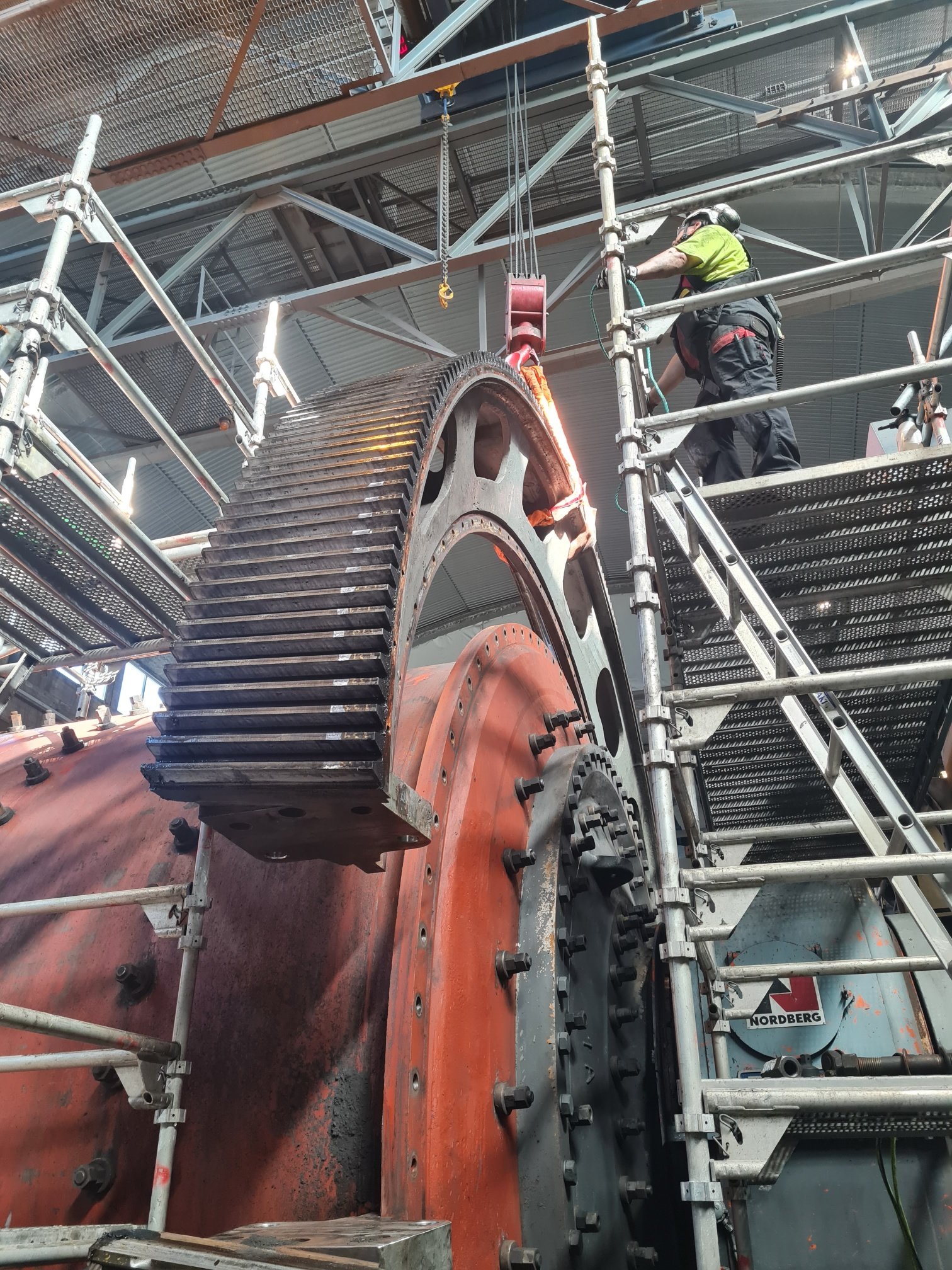
Girth Gear Reversal: When to Flip a Mill or Kiln Girth Gear Instead of Replacing It
Girth gear reversal is the practice of turning a worn girth gear around on its mill or kiln so that the tooth flanks that never carried load become the working flanks. A mill or kiln normally turns in one direction, so only one flank of each tooth wears. Reversal can give the gear a second working life when the unused flanks, the gear body and the mounting are sound, and when the pinion is replaced or flipped at the same time.
Updated
Key points
- A girth gear driven in one direction wears one flank of each tooth; reversal puts the unused flanks to work.
- Metso recommends a gear flip for macropitting or spalling, and for flank cracks before they become a fracture.
- Reversal needs sound unused flanks and roots, a design that can be refitted reversed, and a new or flipped pinion.
- The reversed gear is realigned as a new installation; the gear documentation sets the limits.
On this page (10)
- What is girth gear reversal?
- When should a girth gear be reversed instead of replaced?
- What wear and pitting limits do manufacturers give for reversing a girth gear?
- What must be checked before a girth gear is reversed?
- How is a girth gear reversal planned on a grinding mill?
- How is a girth gear reversed on a rotary kiln?
- How is a girth gear realigned after reversal?
- What are the risks of reversing a girth gear?
- How does Hedberg Technical Services support a girth gear reversal decision?
- Frequently asked questions
What is girth gear reversal?
Girth gear reversal is a repair in which a girth gear is taken off its mounting, turned end for end and refitted, so the previously unloaded tooth flanks become the driving flanks. It is also called a gear flip. It works because mills and kilns run in one direction, so each tooth has one worn working flank and one largely unused flank.
Every tooth on a girth gear has two flanks. The drive pinion pushes on one of them. The opposite flank only touches the pinion during reverse inching or load reversals, so it normally stays close to its original profile.
The pinion can be treated the same way. Metso’s guidance on gear and pinion failures (Demers, 2022, updated 2025) describes pinion flipping as an alternative when no spare is available and the operating pinion has a virgin flank, with the clutch hub and inching drive hub inverted from one end to the other. Philadelphia Gear’s kiln case study calls the kiln pinion typically the weakest link, wearing faster on one side because the kiln turns in one direction. Fuller Technologies, formerly FLSmidth Cement, lists change or reversal and alignment of girth gears, pinions and drives among its gear services.
When should a girth gear be reversed instead of replaced?
A girth gear should be reversed instead of replaced when wear or surface damage is confined to the working flanks, while the unused flanks, rim, web, segment joints and mounting are sound and a pinion with an unworn flank is available. Replacement is the better option when both flanks are damaged, the gear body or joints are cracked, or the gear has already been reversed.
| Condition found | Published guidance | Typical decision |
|---|---|---|
| Localised macropitting on the gear | Metso: surface grinding for profile relief | Repair in place, keep monitoring |
| Macropitting or spalling on the gear’s working flanks | Metso: a gear flip is recommended | Reversal candidate if the unused flanks are sound |
| Scuffing | Metso: pinion and gear flipping are required | Reversal of gear and pinion, plus correction of the cause |
| Cracks on the working flank side | Metso: flipping puts the cracked side into compressive bending, and must be done before cracks become a fracture; gear cracks are assessed case by case | Engineering assessment first, then possible reversal |
| Several failure mechanisms on gear and pinion | Metso: gear and pinions replaced and aligned | Replacement |
| Damage on both flanks, or a gear already reversed | No unused flank remains | Replacement or flank re-machining |
Metso’s leaflet cites significant capital cost savings, and reversal can bridge the lead time for a new gear. Fives offers FCB Nova-Gear on-site machining as a quicker and less expensive alternative, stating that it machines 1 mm on all teeth in under 48 hours on average. For naming the damage, see gear tooth failure modes.
What wear and pitting limits do manufacturers give for reversing a girth gear?
Manufacturers publish few numerical limits for girth gear reversal. Metso's guidance is qualitative: grind localised macropitting, flip the gear for macropitting or spalling, and flip before cracks become fractures. Figures such as 30% pitted area or 12 mm backlash appear on maintenance-software blogs without a cited source. The gear documentation and an inspection decide each case.
| Source | Stated trigger | Applies to | Type of source |
|---|---|---|---|
| Metso, gear and pinion failures roadmap (2022, updated 2025) | Macropitting or spalling on the gear: flip recommended. Flank cracks: flip before they become a fracture. No percentages | Grinding mill gears and pinions | Gear manufacturer guidance |
| Metso leaflet 3711, gear and pinion installation and reversal (2023) | Inspection must confirm the gear is a suitable candidate. No numbers | Mill gears | Gear manufacturer leaflet |
| Fives, specialised maintenance and repair | Reversal usually after 20 to 25 years of operation | Girth gears on rotary equipment | Service provider |
| Oxmaint, ball mill girth gear inspection checklist (2026) | Pitting on more than 30% of the active tooth surface together with backlash above 12 mm | Ball mill girth gears | Maintenance-software blog, no source cited |
| Oxmaint, girth gear monthly PM checklist (2026) | Tooth thickness loss of 20%: engineering review; 30%: replacement planning | Cement plant girth gears | Maintenance-software blog, no source cited |
| Oxmaint, kiln girth gear and pinion maintenance (2026) | Flank loss above 15% of original: high spall risk, replace within 4 weeks | Kiln girth gears | Maintenance-software blog, no source cited |
The numerical figures disagree even within one publisher: 20% thickness loss is a review point on one page and 15% flank loss a replacement trigger on another. They also mix pitted area, tooth thickness and backlash. Backlash is a weak criterion because it also depends on centre distance and runout, and the 12 mm figure has no module. Damage standards such as ISO 10825-1:2022 and ANSI/AGMA 1010-F14 classify tooth damage but set no reversal limits. The gear manufacturer’s documentation governs; where it is silent, measured tooth thickness, crack inspection and the unused flank decide.
What must be checked before a girth gear is reversed?
Before a girth gear is reversed, the unused flanks, tooth roots, rim, web, segment joints and mounting must be inspected, and the design must allow the gear to be refitted the other way round. Metso's reversal leaflet states that inspections confirm whether the gear is a suitable candidate. The pinion must also offer an unworn flank, or a new pinion must be supplied.
- Unused flanks: no pitting, scuffing or impact marks from reverse inching or load reversals.
- Tooth roots on the unused side: these fillets carry the tensile bending stress after reversal, so they need crack examination, for example by the electromagnetic methods in ASTM E2905/E2905M-20.
- Reversibility: the rim, web, bolt pattern and fitted holes, or the kiln spring plates, must allow mounting in the reversed position, and guard seals and spray nozzles must suit it. Confirm in the gear documentation, particularly for helical gears.
- Segment joints and mounting surface: joint bolts and tooth match at each split, the mill flange, or kiln shell roundness and spring plates.
- Pinion: Metso’s leaflet calls a new pinion with an unworn flank ideal, to avoid transmitting tooth profile damage.
- As-found data: runout, backlash, root clearance, contact pattern and pinion temperatures recorded before dismantling.
See girth gear inspection frequency for where these checks fit in the inspection programme.
How is a girth gear reversal planned on a grinding mill?
A girth gear reversal on a grinding mill is planned as a shutdown project. Mill girth gears are usually bolted to a flange on the shell or head, so the work is unbolting the segments, turning them, refitting them in the reversed position and realigning. The pinion is replaced or flipped in the same stop. Metso's leaflet shows a 40,000 lb gear segment being prepared for reversal.
- Inspect and measure at an earlier stop, and confirm reversibility in the gear documentation.
- Order the pinion, bolts, seals and any guard changes needed for the reversed orientation.
- Prepare the lifting plan, segment supports and a method to secure the mill while segments are off.
- Mark each segment and joint, remove guard and spray equipment, then unbolt, lift, turn and refit the segments to the specified bolt values.
- Measure and correct radial and axial runout, then fit and align the new or flipped pinion.
- Check the contact pattern, refit guard and lubrication, run in and confirm with thermography.
Segment mass, crane access and alignment time drive the shutdown length, and should be estimated from the drawings and a site visit.
How is a girth gear reversed on a rotary kiln?
A girth gear on a rotary kiln is reversed on the same principle, but kiln gears are often carried on spring plates welded to the shell. The work therefore includes releasing and re-welding the mounting as well as unbolting. A World Cement case study of a Saudi Arabian cement plant (2012) reports the reversal and realignment with 20 days of downtime, working around the clock.
The World Cement article describes the main steps on that kiln:
- The gear was dismantled in two halves, held by a temporary fixing system, alignment supports and torsion stoppers while the kiln was rotated.
- Both halves were reversed and tacked to the shell, and the spring plates were preheated and welded.
- The pinion was heated and pressed off its shaft for reversal, then refitted.
- After welding, the gear’s axial and radial movement was within tolerance, and the pinion contact pattern and clearance were set.
Kiln shells also change shape. Philadelphia Gear’s case study notes that the girth gear had to be centred on a kiln that had become oval. Shell growth, shell crank and axial float make the hot mesh differ from the cold one, as explained in the girth gear alignment guide. See also kiln drive systems.
How is a girth gear realigned after reversal?
After reversal, a girth gear is realigned to the shell axis by measuring radial and axial runout over a full revolution and correcting at the mounting. The pinion is then set by root clearance, backlash at both ends of the face and contact pattern. The limits come from the gear documentation. Thermography under load confirms the result.
Old settings do not carry over, because the gear sits in a new position.
- Runout: read at numbered positions with dial indicators or laser, with the high point of radial runout marked.
- Pinion position: Metso advises aligning a pinion to a used gear by root clearance, because profile wear makes backlash unreliable.
- Contact and temperature: marking compound at standstill, the running pattern after start-up, and the temperature profile across the pinion under load.
Methods are covered in the girth gear alignment and backlash and root clearance guides. Record all values as the new baseline.
What are the risks of reversing a girth gear?
The main risks of reversing a girth gear are hidden cracks in the tooth roots that will carry tensile stress after reversal, pairing the reversed gear with a worn pinion, mounting or welding defects, and poor realignment. Reversal also uses up the gear's last unused flank, so the next step after a reversed gear wears out is replacement or re-machining.
- Undetected root cracks: the roots on the unused side have not carried tensile bending stress before, so crack examination comes first.
- Worn pinion: damaged pinion profiles transfer to the reversed gear, which is why Metso recommends a new pinion.
- Cracks left too long: Metso notes that once flank cracks become a fracture, flipping is no longer possible.
- Kiln mounting work: spring plate welding and bolt fitting on hard parts add risk and time, as the Saudi Arabian case shows.
- Alignment: joint mismatch, runout or a wrong pinion position shortens the second life.
Plan a new gear for the end of the reversed life, because no unused flank remains.
How does Hedberg Technical Services support a girth gear reversal decision?
Hedberg Technical Services supports a girth gear reversal decision with on-site girth gear inspection: wear measurement, alignment assessment, backlash and root clearance assessment, runout and wobble measurement, and mounting inspection. The written report includes a remaining service life assessment and a recommendation on replacement timing, which gives a basis for choosing between reversal, repair and a new gear set.
Per Hedberg has more than 25 years of hands-on experience with industrial and marine gearboxes. Project experience includes the installation of a new girth ring gear and pinion at Kiruna, Sweden, and inspection and alignment of a kiln pinion and girth ring gear at Leirosa, Portugal. See girth gear services for the full scope.
Hedberg Technical Services is independent and is not affiliated with, authorized by or a service partner of Metso, Fuller Technologies, FLSmidth, Fives or Philadelphia Gear. Brand names are used only to identify equipment and published sources.
Frequently asked questions
Can every girth gear be reversed?
No. A girth gear can only be reversed when its unused flanks and tooth roots are sound, the rim, joints and mounting are undamaged, and the design allows it to be refitted the other way round. Damage on both flanks, cracked gear bodies or a gear that has already been reversed rule it out.
Should the pinion be replaced when a girth gear is reversed?
Usually, yes. Metso's reversal leaflet states that a new pinion with an unworn flank is ideal, so worn pinion profiles are not transmitted to the reversed gear. Metso also describes flipping the existing pinion as an alternative when no spare is available and the pinion still has a virgin flank.
How long does a girth gear reversal take?
Girth gear reversal time depends on gear size, mounting type, crane access and alignment work. One published case, a kiln at a Saudi Arabian cement plant described by World Cement in 2012, restarted after 20 days of downtime with work around the clock. Kiln gears on welded spring plates add mounting work that bolted mill gears do not need.
Can a girth gear be reversed twice?
Normally no. After one reversal both flanks of each tooth have carried load, so turning the gear again would put the originally worn flanks back into service. When a reversed girth gear wears out, the options are replacement or on-site re-machining of the flanks where the remaining tooth thickness allows it.
What is the difference between a gear flip and a pinion flip?
A gear flip turns the girth gear so its unused flanks carry the load. A pinion flip turns the pinion end for end so its unused flanks are used. Metso notes that a pinion flip requires the clutch hub and inching drive hub to be inverted from one end of the shaft to the other.
Is girth gear reversal cheaper than replacement?
Girth gear reversal is generally cheaper than a new gear because the existing gear is reused, and Metso describes significant capital cost savings. It still needs a shutdown, a pinion, lifting and full realignment. Fives offers on-site flank re-machining as a quicker and less expensive alternative to reversal.
Sources and standards
- J. B. Demers, Metso, Preventing disasters: A roadmap to understanding gear and pinion failures (2022, updated November 2025)
- Metso, Gears and pinions: Installation and reversal, leaflet 3711-08-21-EN-MSE (2023)
- G. Teutrine, Maintaining excellence: reversing gears at a Saudi cement plant, World Cement, 28 November 2012
- Fives, Specialized maintenance and repair (FCB Nova-Gear)
- Fuller Technologies (formerly FLSmidth Cement), Gear services
- Philadelphia Gear, Replacing a critical kiln's massive gear drive (case study)
- Oxmaint, Ball Mill Girth Gear Inspection Checklist (10 June 2026)
- Oxmaint, Girth Gear Monthly PM Checklist (Backlash, Lubrication, Wear Pattern) (21 May 2026)
- Oxmaint, Kiln Girth Gear and Pinion Maintenance: Lubrication and CMMS (8 July 2026)
- ASTM E2905/E2905M-20, Standard Practice for Examination of Mill and Kiln Girth Gear Teeth: Electromagnetic Methods
- ISO 10825-1:2022, Gears: Wear and damage to gear teeth, Part 1: Nomenclature and characteristics
- ANSI/AGMA 1010-F14, Appearance of Gear Teeth: Terminology of Wear and Failure
Keep reading
Related pages
Girth Gear Backlash by Module
Girth gear backlash by module: published backlash and root clearance figures for mills and kilns compared, why they conflict, and what governs hot…
Read more →
Girth Gear Services
Girth gear inspection and alignment for rotary kilns and mills: backlash, root clearance, runout, wear and new girth gear and pinion installation, on…
Read more →
Girth Gear Alignment
Girth gear alignment explained: radial and axial runout, pinion alignment, contact pattern, thermal checks and hot kiln effects on grinding mills and…
Read more →
Girth Gear Inspection Frequency
Girth gear inspection frequency for kilns and mills: what to check while running, what to measure at stops, and how temperature trends set the…
Read more →
Gear Tooth Failure Modes
Gear tooth failure modes in ISO 10825-1 and AGMA 1010 terms: how pitting, micropitting, scuffing, wear and cracks look, their causes and what to do.
Read more →
Girth Gear Backlash and Root Clearance
Girth gear backlash and root clearance explained: definitions, the difference between them, how to measure them on mills and kilns, and what changes…
Read more →
Get in touch
Talk to a gearbox specialist
Weighing a girth gear reversal against a new gear set? Send Per Hedberg the inspection data or photos and the gear details for a direct technical answer.
Phone +34 621 03 40 48 · Email hedbergtech@pm.me