
Marine Gearbox Overhaul Afloat: Which Work Needs a Dry Dock?
A marine gearbox overhaul afloat covers most work on gearboxes that sit inside the hull. Bearings, clutch packs, gear set inspection, seals, the oil system, alignment checks and bearing bore machining can usually be done with the vessel alongside the quay. Work below the waterline, such as a thruster lower gearbox or a propeller shaft withdrawal, needs divers, an underwater-mountable design or a dry dock. This guide sets out each task and the conditions that decide it.
Updated
Key points
- Gearbox work inside the hull, including bearings, clutch packs, seals, the oil system and gear set inspection, can usually be done afloat.
- The lifting route, hatch and door openings, crane capacity at the berth and secure locking of the shaft decide whether large components can be handled alongside.
- A thruster lower gearbox needs a dry dock unless the thruster is designed for underwater removal or a diving contractor can exchange it afloat.
- Under Bureau Veritas rules, a complete tailshaft survey includes withdrawal of the shaft, which normally means dry dock.
- Repairs that affect class must be notified to the class society, and the surveyor decides attendance and acceptance.
On this page (9)
- Which marine gearbox overhaul work can be done afloat?
- What decides whether gearbox work can be done alongside the quay?
- Can bearings, clutch packs and gear sets be replaced with the vessel afloat?
- Can bearing bores in a marine gearbox be machined without dry dock?
- Which thruster gearbox work needs dry dock or divers?
- Why does propeller shaft and stern tube work usually need dry dock?
- Should marine gearbox alignment be checked afloat?
- How is the class society involved when gearbox work is done afloat?
- Frequently asked questions
Which marine gearbox overhaul work can be done afloat?
Most marine gearbox overhaul work can be done afloat, with the vessel alongside the quay, because the main propulsion gearbox and the thruster upper gearboxes sit inside the hull. Bearings, clutch packs, seals, oil system work, gear set inspection, alignment checks and bearing bore machining are usually afloat tasks. Underwater thruster gearboxes and propeller shaft withdrawal normally need divers or a dry dock.
The table gives the usual answer for each task and the condition that decides it.
| Task | Where it is normally done | Deciding conditions |
|---|---|---|
| Bearing replacement in the main gearbox | Afloat | Lifting points and space above the gearbox; shaft locked against rotation; shafts supported while bearing caps are off |
| Clutch packs (multi-disc clutches) | Afloat | Room to withdraw the clutch shaft or pack; hydraulic and control lines isolated; clutch engagement tested at commissioning |
| Gear set inspection | Afloat | Top cover can be lifted; gears can be turned slowly; contact pattern and backlash can be recorded |
| Gear set replacement | Usually afloat | A lifting route exists for the heaviest wheel; if hatches are too small, any temporary access opening is agreed in advance |
| Gearbox shaft seals | Afloat | Input and output seals on the gearbox itself; stern tube seals are a separate case |
| Oil system: pump, cooler, filters, piping, flushing, oil change | Afloat | Sea water side of the cooler isolated; storage and disposal of oil arranged at the berth |
| Alignment check, gearbox to engine and shafting | Afloat (preferred) | The vessel is in its operating condition; readings are taken as the alignment procedure requires |
| Bearing bore machining | Usually afloat | Space to mount a portable machine on the housing; stable set-up; interior protected from chips |
| Thruster upper gearbox and steering gear | Afloat | Accessed from the thruster room inside the hull |
| Thruster lower (underwater) gearbox | Dry dock, or afloat with divers | Thruster designed for underwater mounting, or a diving contractor with an approved procedure |
| Propeller shaft withdrawal and stern tube bearings | Dry dock | Propeller removal and shaft withdrawal; some seal work can be done in water by specialists |
Hedberg Technical Services overhauls marine gearboxes on board. In most cases a full overhaul can be done in port with the vessel alongside the quay, without dry dock. See marine propulsion gearbox overhaul.
What decides whether gearbox work can be done alongside the quay?
Whether marine gearbox work can be done alongside the quay depends on five conditions: a lifting route for the heaviest component, hatch and door openings large enough for it, crane capacity at the berth, secure locking of the propeller shaft and engine, and enough berth time with class attendance arranged. These conditions are checked during pre-mobilization planning, before anyone travels to the vessel.
- Lifting route: the weight of each component from drawings or the manual, the engine room crane or rated lifting points, and a clear path from the gearbox to the deck.
- Hatch and door sizes: the clear opening of engine room hatches, casings and doors, measured against the largest part, such as a gear wheel, housing cover or clutch shaft. If a part does not fit, the job is planned around dismantling it further or around an agreed temporary opening.
- Crane at the berth: a mobile or quay crane with the capacity and outreach for the lift, and space on the quay to set it up.
- Shaft and engine locking: water flowing past the propeller from current, tide or passing ships can turn the shaft. The shaft is locked, and the main engine and turning gear are isolated before the gearbox is opened.
- Berth time and class: the work window is agreed with the operator and the port, and the class society is informed early so the surveyor can attend the steps that matter.
All precision tooling and measuring equipment are brought to site.
Can bearings, clutch packs and gear sets be replaced with the vessel afloat?
Yes. Bearings, clutch packs and gear sets in a marine propulsion gearbox can usually be replaced with the vessel afloat, because the work is done from inside the engine room once the top cover is lifted. The limit is handling: the heaviest gear wheel or clutch shaft needs a lifting route out of the engine room, or the job must be planned around that constraint.
A typical on-board sequence is:
- Record as-found data: backlash, end float, contact marks and oil condition.
- Lift the top cover and remove bearing caps with the shafts supported.
- Lift out shafts, clutch packs or gears and inspect them, with tooth damage described in standard terms. See gear tooth failure modes.
- Replace worn parts, check bearing seats and reassemble to the specified clearances.
- Verify backlash and contact pattern, refill and flush the oil system.
- Commission the gearbox with functional testing.
Before the vessel returns to service, Hedberg Technical Services carries out functional testing including vibration analysis and performance verification.
Can bearing bores in a marine gearbox be machined without dry dock?
Yes. Bearing bores in a marine gearbox can be machined without dry dock by mounting a portable boring machine on the gearbox housing inside the engine room. The housing stays on its foundation, so its position relative to the engine and shafting is kept. The conditions are space around the housing for the machine, a stable set-up and protection of the gearbox interior from chips.
Bore machining restores the seat of a bearing that has spun or worn in the housing. Bore diameter, roundness and position are measured before and after the work. See gearbox bearing bore repair on site and mobile machining.
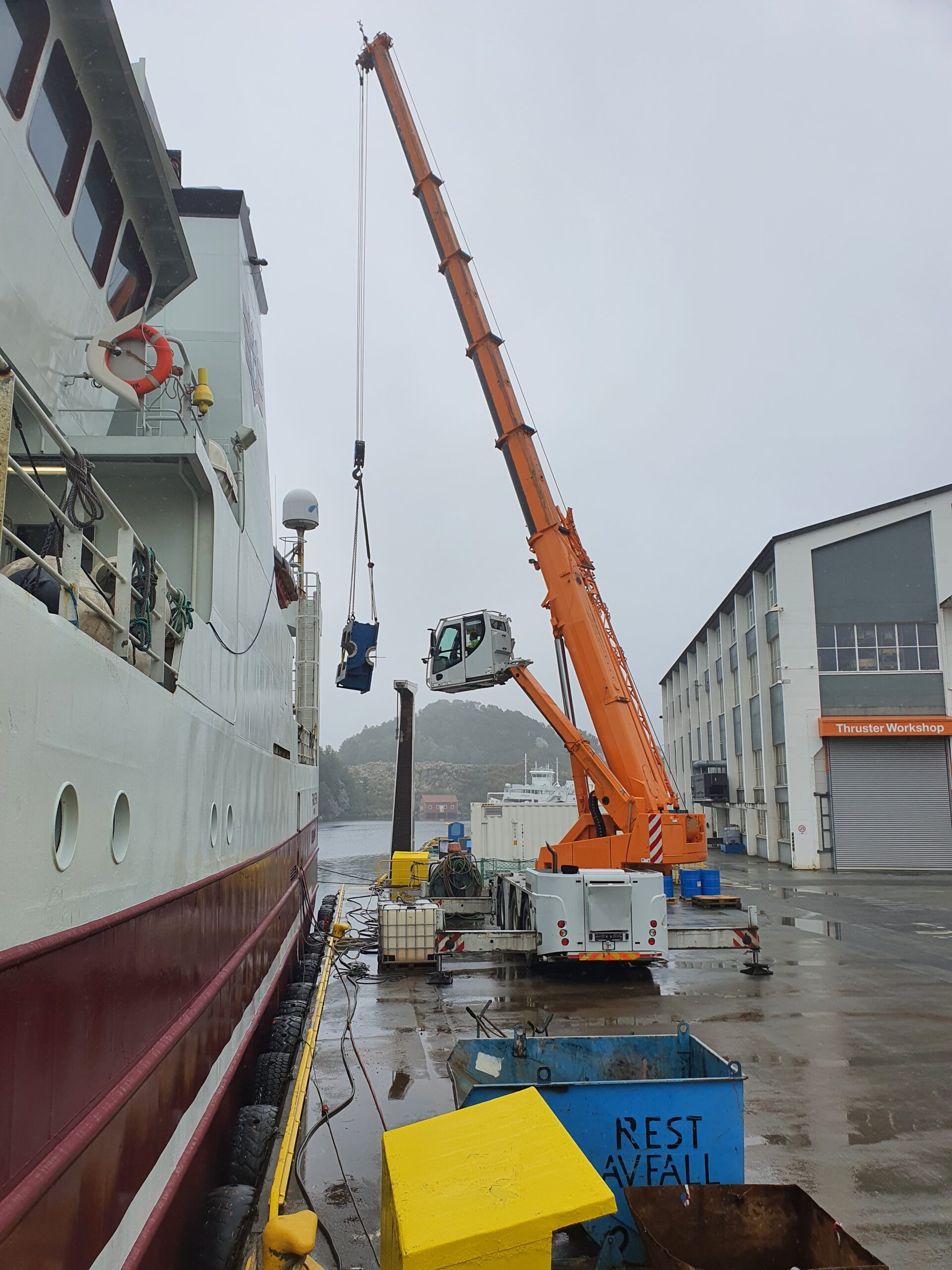
Project experience at Rubbestadneset, Norway includes a complete overhaul of a marine gearbox with machining of its bearing bores. The project photograph shows a mobile crane lifting gearbox components at the quay beside the vessel. See the Rubbestadneset project page.
Which thruster gearbox work needs dry dock or divers?
Thruster gearbox work below the waterline needs dry dock or divers, unless the thruster is designed for removal afloat. The upper gearbox, steering gear and drive components in the thruster room can be overhauled afloat. The underwater lower gearbox can be exchanged afloat on underwater-mountable designs or by specialist diving contractors. On other designs it needs a dry dock.
Published examples show the range of options:
- Designed for underwater mounting: Kawasaki states that its underwater-mounting Rexpeller azimuth thrusters can be mounted or dismantled underwater, with no dry docking required for thruster maintenance.
- Diver-based exchange: Wärtsilä Underwater Services lists azimuth thruster repair and lower gear replacement, and complete lower gearbox exchange on tunnel thrusters. MarineLink reported in June 2022 that Hydrex divers removed a bow thruster from a 191 m RoRo ship in Rotterdam and installed a new, fully assembled unit afloat.
- Cofferdam: The Maritime Executive reported in 2011 on an in-water overhaul of four azimuth thrusters on a semi-submersible rig using a hyperbaric cofferdam, with a class surveyor witnessing critical steps.
Class rules still apply. Bureau Veritas NR467 (July 2026) requires, at class renewal, an external examination of the propulsive part of a thruster at the dry dock survey, with lubricating oil analysis results to detect deterioration of internal gears and bearings or the presence of water. Dismantling may be required if these checks are not satisfactory. See thruster gearbox overhaul.
Why does propeller shaft and stern tube work usually need dry dock?
Propeller shaft and stern tube work usually needs dry dock because the propeller must be removed and the shaft withdrawn to examine the stern tube bearings. Under Bureau Veritas rules, a complete tailshaft survey includes complete withdrawal of the shaft, unless the MON-SHAFT condition monitoring notation applies and the monitoring data are within permissible limits. Some seal work can be done in water by specialists.
Bureau Veritas NR467 Part A, Chapter 3, Section 5 describes two tailshaft survey types: a complete survey and a modified survey. The complete survey includes removal of the propeller, withdrawal of the shaft, crack detection at the aft end, examination of bearing surfaces and seals, and recording of clearances. With the MON-SHAFT notation, the shaft need not be withdrawn if the monitoring data, such as aft bearing temperature and oil analysis, are acceptable to the surveyor.
Wärtsilä Underwater Services lists wet repair and replacement of face-type seals, so a leaking stern seal does not always mean dry dock.
The gearbox side of the drive line is independent of this. The output flange, coupling and gearbox bearings can be overhauled afloat. If a shaft withdrawal is due soon, it can make sense to combine the gearbox work with the dry dock.
Should marine gearbox alignment be checked afloat?
Yes. Marine gearbox and shaft alignment should be checked afloat, because the hull deflects differently afloat than on blocks in a dry dock, and the gearbox runs in the afloat condition. The ABS Guidance Notes on Propulsion Shafting Alignment (2019) describe bearing reaction measurements by the jack-up method with the vessel in the light afloat condition to verify the alignment.
The ABS Guidance Notes state that sag and gap measurements alone are insufficient to accept a shaft alignment condition. They must be validated with bearing reaction measurements after the shafting is assembled.
For the gear mesh, the same Guidance Notes describe coating the pinion teeth with a contrasting dye and turning the gears through a full revolution with the turning gear. An acceptable result shows markings across 90% or more of the face width. A contact mark to one side indicates misalignment that must be corrected.
After an overhaul, alignment data and contact pattern are recorded in the report.
How is the class society involved when gearbox work is done afloat?
The class society must be informed before marine gearbox repairs that affect class, whether the work is done afloat or in dry dock, and its surveyor decides which steps to attend. Under Bureau Veritas rules, class can be suspended when repairs affecting class are carried out without requesting the Society's attendance or not to the Surveyor's satisfaction. The written report supports the surveyor's assessment.
Bureau Veritas NR467 Part A states that reduction gears, including clutch arrangements, are opened up for visual inspection as deemed necessary by the Surveyor, and that gears and roller bearings in complicated assemblies may be surveyed without dismantling.
Steps the surveyor often wants to see or receive data from:
- The opened gearbox and the as-found condition.
- Replaced bearings, gears or clutch parts.
- Contact pattern, backlash and alignment results.
- Functional testing before the vessel returns to service.
Hedberg Technical Services writes a technical report with disassembly findings, component measurements, photographs, parts replaced, alignment data and commissioning data. The report is suitable for class documentation and maintenance records. Acceptance of the repair stays with the class society. See marine gearbox services.
Frequently asked questions
Can a marine gearbox be overhauled without dry docking?
Yes. In most cases a full marine gearbox overhaul can be carried out in port with the vessel alongside the quay, without dry docking. Access, lifting routes and logistics are assessed during pre-mobilization planning. Work below the waterline, such as a thruster lower gearbox or propeller shaft withdrawal, is the main exception.
Can a thruster lower gearbox be replaced afloat?
Sometimes. It depends on the thruster design. Some azimuth thrusters are designed to be mounted and dismantled underwater, and specialist diving contractors have exchanged lower gearboxes and complete tunnel thrusters afloat. Other designs need a dry dock. The thruster manual and the class society decide which method is acceptable for a given vessel.
Does the propeller shaft need to be locked during a gearbox overhaul alongside?
Yes. Water flowing past the propeller from current, tide or passing ships can turn the shaft while the gearbox is open. The shaft is locked and the main engine and turning gear are isolated before work starts, so gears, shafts and bearings cannot move while they are being handled.
Is a class surveyor needed for a gearbox overhaul done alongside the quay?
Usually the class society must be informed, because a gearbox overhaul often involves repairs that affect class. The surveyor decides which steps to attend, such as the opened gearbox, replaced parts and functional testing. Informing class early avoids delays at the end of the job, when the vessel is due to sail.
Is bearing bore machining possible on board a vessel?
Yes. Worn bearing bores can be machined on board with a portable boring machine mounted on the gearbox housing, so the housing stays on its foundation. The conditions are space to mount the machine and a stable set-up. Bore size, roundness and position are measured before and after machining.
What testing is done before the vessel sails after a gearbox overhaul?
Hedberg Technical Services carries out functional testing including vibration analysis and performance verification before the vessel returns to service. Alignment data, contact patterns and commissioning data are recorded in the written technical report, which is suitable for class documentation and the vessel's maintenance records.
Sources and standards
- Bureau Veritas NR467 Rules for the Classification of Steel Ships, Part A: Classification and Surveys, NR467 A DT R26, July 2026
- ABS Guidance Notes on Propulsion Shafting Alignment, September 2019
- Wärtsilä Underwater Services
- Underwater Mounting Rexpeller, Kawasaki Heavy Industries
- Hydrex Completes RoRo Bow Thruster Replacement in Rotterdam, MarineLink, 1 June 2022
- Overhaul required. Dry Dock required REALLY?, The Maritime Executive, 1 September 2011
Keep reading
Related pages
Non-OEM Gearbox Repair, Warranty and Class
Non-OEM gearbox repair explained: when warranty terms limit independent service, how class societies survey repairs, OEM parts and the records to…
Read more →
Gearbox Borescope Inspection
Gearbox borescope inspection: what an endoscope can and cannot see, access points, gear tooth and bearing checks, when to open the gearbox and what…
Read more →
Marine Propulsion Gearbox
Marine propulsion gearbox overhaul in port, in most cases without dry dock: reduction gearboxes, clutches and bearing bores, with a class-ready…
Read more →
Thruster Gearbox
Thruster gearbox overhaul for azimuth and bow thrusters, planned around port calls: upper gearbox, bevel gears, bearings and seals, with a written…
Read more →
Marine
Marine gearbox overhaul with the vessel alongside the quay, in most cases without dry dock. Propulsion, thruster and winch gearboxes; class-ready…
Read more →
Marine Gearbox Overhaul, Rubbestadneset, Norway
Marine gearbox overhaul at Rubbestadneset, Norway: project experience in a complete overhaul with bearing bore machining, and what the work involves.
Read more →
Get in touch
Talk to a gearbox specialist
Planning a marine gearbox overhaul around a port call? Contact Per Hedberg to check access, lifting and scope before the vessel arrives.
Phone +34 621 03 40 48 · Email hedbergtech@pm.me