
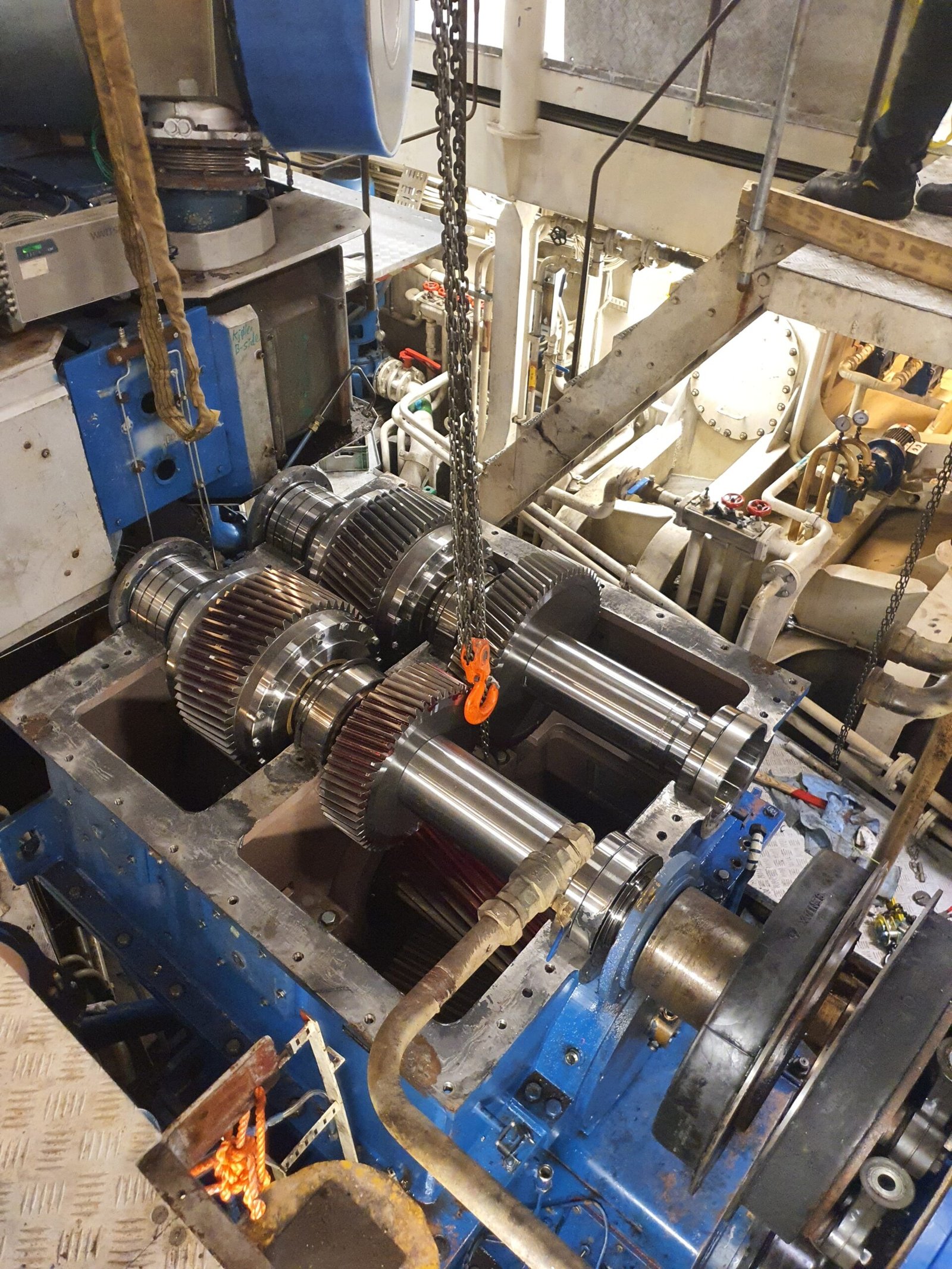
Gearbox Repair or Replace: How to Decide for an Industrial Gearbox
The gearbox repair or replace decision depends on five factors: the condition of the housing, the condition of the gears, the bearings and shafts, the availability and lead time of a new unit, and the cost of downtime. A sound housing with replaceable damage usually favours repair. This guide sets out how to assess each factor, when replacement is the better choice and how a repair can be used to upgrade the gearbox.
Updated
Key points
- Repair is usually viable when the housing is sound and the damage is limited to gears, bearings, seals or shafts that can be replaced or reworked.
- Worn or damaged bearing bores do not automatically mean a new gearbox: they can often be restored by machining.
- Total time until the equipment runs again, including delivery, transport and installation, often decides the case.
- Repairers quoted in Gear Technology (August 2018) typically move to replacement when repair cost reaches about 50 to 70% of a new unit.
- A repair is an opportunity to upgrade bearings, seals, lubrication and monitoring, especially on large gearboxes.
On this page (9)
- Gearbox repair or replace: how do you decide?
- How does the condition of the gearbox housing affect the decision?
- When can damaged gears be reused, reworked or replaced?
- How do bearings, shafts and seals influence the decision?
- How do lead time and downtime cost change the decision?
- Can a gearbox repair be used to upgrade the gearbox?
- When is replacing the gearbox the better choice?
- How does Hedberg Technical Services support a repair or replace decision?
- Frequently asked questions
Gearbox repair or replace: how do you decide?
An industrial gearbox should usually be repaired when the housing is sound, the damage is limited to parts that can be replaced or reworked, and the repair returns the equipment to service sooner than a new unit can be delivered and installed. Replacement is the better choice when the housing is beyond repair, the unit is undersized for its duty or repair cost approaches that of a new gearbox.
The decision is easier when each factor is assessed separately:
| Factor | Favours repair | Favours replacement |
|---|---|---|
| Housing | No structural cracks; bores and joint faces intact or repairable by machining | Cracks through load-carrying walls or bore areas; distortion that moves bore centres |
| Gears | Mild or stable damage; pinion or single stage replaceable | Several stages damaged; cracked or broken teeth on several gears |
| Bearings and shafts | Standard bearings available; shafts repairable or remade | Special bearings or shafts with lead times longer than a new unit |
| New unit | Long lead time or obsolete model | Available quickly as a direct replacement |
| Duty | Gearbox suited to the current load | Repeated failures because the duty has outgrown the design |
| Downtime | On-site repair is faster than delivery and installation of a new unit | A spare or exchange unit can be installed in one stop |
Each case needs an inspection of the opened gearbox. See industrial gearbox inspection.
How does the condition of the gearbox housing affect the decision?
The condition of the gearbox housing is often the deciding factor, because the housing holds the bearing bores that set shaft position, gear centre distance and mesh alignment. A housing with no structural cracks and with bores that are intact or repairable can usually be reused. Cracks through load-carrying walls or distortion that moves the bore centres need an engineering assessment before repair is chosen.
Housing checks during the assessment include:
- Bearing bore diameter, roundness and wear marks from bearing creep or fretting.
- Bore position: centre distances and parallelism between shafts.
- Flatness of split-line joint faces and mounting feet.
- Cracks around bores, ribs and feet, confirmed with non-destructive testing.
- Damage to threads, dowel holes and inspection covers.
Worn bearing bores are a common finding after a bearing has spun in the housing. They can often be restored on site by line boring and sleeving. See gearbox bearing bore repair on site and mobile machining. A cracked housing is assessed case by case: crack location and whether it passes through a bore or load path matter more than crack length alone.
When can damaged gears be reused, reworked or replaced?
Damaged gears can be reused when the damage is mild and stable, reworked when limited damage can be removed without weakening the teeth, and must be replaced when there are cracks, broken teeth or progressive pitting over a large part of the flanks. The assessment uses standard failure mode terminology, measurements, contact pattern checks and crack testing of the teeth.
Gear condition is classified with the terms of ISO 10825-1 or ANSI/AGMA 1010 so that the decision rests on recorded facts. See gear tooth failure modes.
- Reuse: polishing wear, mild scuffing that has stabilised, limited non-progressive pitting.
- Rework: local damage that can be dressed or ground without removing too much material, where the gear manufacturer’s limits allow it.
- Replace: any crack, broken teeth, severe or progressive macropitting, case crushing or heavy wear that has changed the profile.
Pinions see more load cycles than the gears they drive and are replaced more often. Repairers quoted in Gear Technology note that larger gears, which see fewer revolutions, can often be saved by reconditioning, while pinions are replaced. Replacing a pinion alone requires checking that the new pinion runs correctly with the existing worn gear.
How do bearings, shafts and seals influence the decision?
Bearings, seals and most shaft damage rarely justify replacing a complete gearbox on their own, because standard bearings and seals can be replaced and shafts can often be repaired or remade. They matter because the cause of a bearing failure, such as misalignment, contamination, poor lubrication or a worn bearing seat, must be found and corrected, or the new bearing will fail in the same way.
A bearing failure is often a symptom. In Gear Technology’s survey of repairers, Xtek notes that the root cause of bearing failures is often found outside the bearing itself, in rust, contamination, loads or misalignment. Bearing damage should be described with the terms of ISO 15243:2017, which classifies rolling bearing damage by mode and possible cause.
Points to check:
- Availability of large or special bearings, which can have longer lead times than standard sizes.
- Shaft journal and seal surface condition, and whether a shaft can be repaired or must be remade.
- Seal type and breather condition, since leaks and contamination often start here.
- Gear damage caused by bearing wear, such as one-sided contact.
How do lead time and downtime cost change the decision?
Lead time and downtime cost often decide between repair and replacement, because each day a mill, kiln or vessel stands still can cost more than the gearbox work itself. The fair comparison is total time until the equipment runs again: delivery and installation of a new or exchange unit, against on-site repair, or workshop repair including removal, transport and refitting.
Gear Technology notes that the lead time to repair a gearbox is typically shorter than sourcing, procuring and shipping an exact replacement gearbox. Shipping a large industrial gearbox to a workshop typically means 4 to 12 weeks of downtime in Hedberg Technical Services’ experience. An on-site cement mill gearbox overhaul typically takes 3 to 10 days, depending on size and condition, with a timeline estimate given after the initial assessment.
To compare options:
- Get the confirmed lead time for a new or exchange unit, including any adaptations to foundations, couplings or guards.
- Estimate removal, transport and installation time for each route.
- Multiply the total by the cost of lost production per day.
- Add the risk: transport damage, unknown findings after disassembly, commissioning time.
See on-site vs workshop gearbox overhaul and on-site gearbox overhaul.
Can a gearbox repair be used to upgrade the gearbox?
Yes. A gearbox repair can be used to upgrade bearings, seals, lubrication, breathers and condition monitoring points while the unit is open, which addresses the cause of the failure and can extend service life. Gear Technology's Charles D. Schultz notes that the larger the gearbox, the more likely upgrades to gears, shafts, bearings and seals save time and money.
Typical upgrades during a repair:
- Bearings with a more suitable type, cage or clearance for the actual load and speed.
- Improved seals, such as labyrinth or combined seal arrangements in dusty environments.
- Better oil filtration, cooling or circulation.
- Filtered or desiccant breathers.
- Sensor mounting points for vibration and temperature monitoring.
Any change to gear geometry, material, bearing arrangement or rating needs a design check against the original duty. The same Gear Technology article notes that small gearboxes are less likely to justify an upgrade and are often replaced with a modern equivalent. Upgrades fit naturally into a long-term plan. See gearbox lifetime management.
When is replacing the gearbox the better choice?
Replacing the gearbox is the better choice when the housing cannot be repaired, when several gear stages are damaged, when the duty has outgrown the design and failures repeat, or when a suitable new or exchange unit can be installed sooner and at lower total cost than a repair. Small, standard gearboxes are also more often replaced than repaired.
Repairers quoted in Gear Technology (August 2018) give rules of thumb for the cost threshold: Atlanta Gear Works typically replaces when repair cost is 50 to 60% or more of a new unit, and Xtek when reconditioning reaches around 60 to 70%. Xtek also points out that a new unit does not carry the freight, disassembly and inspection costs of a repair, so the comparison must use full costs on both sides.
Replacement also needs planning: foundation and coupling interfaces, alignment of the new unit and commissioning. A replaced gearbox that is installed without correct alignment can fail early.
How does Hedberg Technical Services support a repair or replace decision?
Hedberg Technical Services supports the repair or replace decision by inspecting the gearbox on site, measuring housing, gears and bearings, and delivering a written technical report with findings, measurements, photographs and recommendations. The company is independent of gearbox manufacturers, so the recommendation is based on the condition found and the downtime involved.
Per Hedberg has more than 25 years of hands-on experience with industrial and marine gearboxes. Hedberg Technical Services works on helical, bevel, planetary, worm and combined designs. If repair is chosen, the on-site overhaul covers disassembly, inspection, component replacement, reassembly, alignment verification and commissioning, with all precision tooling and measuring equipment brought to site.
For a gearbox that has already failed, see emergency gearbox breakdown support.
Frequently asked questions
How long does an on-site industrial gearbox repair take?
It depends on gearbox size, condition and parts availability. Hedberg Technical Services states that an on-site cement mill gearbox overhaul typically takes 3 to 10 days. A timeline estimate is given after the initial assessment. Shipping a large gearbox to a workshop typically means 4 to 12 weeks of downtime in the company's experience.
Can a cracked gearbox housing be repaired?
Sometimes. It depends on where the crack is, the housing material and whether the crack passes through a bearing bore or main load path. Cracks in non-structural areas can often be repaired, while cracks through bore areas or main walls need an engineering assessment and may make replacement the safer choice.
At what repair cost should a gearbox be replaced?
There is no fixed rule. Repairers quoted in Gear Technology in August 2018 typically recommend replacement when repair cost reaches about 50 to 70% of a new unit. Lead time, downtime cost and whether the gearbox suits its duty often matter more than the cost ratio alone.
Should the pinion be replaced if the gear is reused?
Often yes. The pinion makes more load cycles than the gear it drives, so it usually shows more wear and fatigue damage. Replacing the pinion and reusing a gear in acceptable condition is common, provided the contact pattern and backlash are checked so the new pinion runs correctly with the existing gear.
Does a repaired gearbox need commissioning checks?
Yes. A repaired gearbox should have alignment verified and be commissioned with checks of temperatures, noise, vibration and lubrication before returning to full load. Hedberg Technical Services includes alignment verification and commissioning in its on-site overhauls and records the data in the written report.
Sources and standards
- The Three Rs of Gearbox Repair: Repair, Refurbish, Replace, Jack McGuinn, Gear Technology, August 2018
- Is it Worth Upgrading?, Charles D. Schultz, Gear Technology, October 2018
- ISO 10825-1:2022 Gears — Wear and damage to gear teeth — Part 1: Nomenclature and characteristics (ISO)
- ANSI/AGMA 1010-F14 Appearance of Gear Teeth — Terminology of Wear and Failure (ANSI Webstore)
- ISO 15243:2017 Rolling bearings — Damage and failures — Terms, characteristics and causes (ISO)
Keep reading
Related pages
On-Site Gearbox Overhaul
On-site gearbox overhaul for mill, kiln and marine gearboxes, done where the gearbox stands. Avoid 4 to 12 weeks of workshop downtime. Full written…
Read more →
Industrial Gearbox Inspection
On-site industrial gearbox inspection for mining, cement and marine drives. Find wear, damage and remaining service life before they stop production.
Read more →
On-Site vs Workshop Gearbox Overhaul
On-site vs workshop gearbox overhaul compared: downtime, transport risk, lifting, access and cost drivers, and when a workshop is the better choice.
Read more →
Gearbox Bearing Bore Repair On Site
Gearbox bearing bore repair on site: why bores wear (spun bearings, fretting), how line boring and sleeving restore them, and how to verify the…
Read more →
Gear Tooth Failure Modes
Gear tooth failure modes in ISO 10825-1 and AGMA 1010 terms: how pitting, micropitting, scuffing, wear and cracks look, their causes and what to do.
Read more →
Gearbox Lifetime Management
Gearbox lifetime management: remaining-life assessment, condition monitoring strategy and maintenance planning that turn breakdowns into planned…
Read more →
Get in touch
Talk to a gearbox specialist
Weighing repair against a new gearbox? Contact Per Hedberg for an on-site inspection and a written report that sets out the condition and the options.
Phone +34 621 03 40 48 · Email hedbergtech@pm.me