
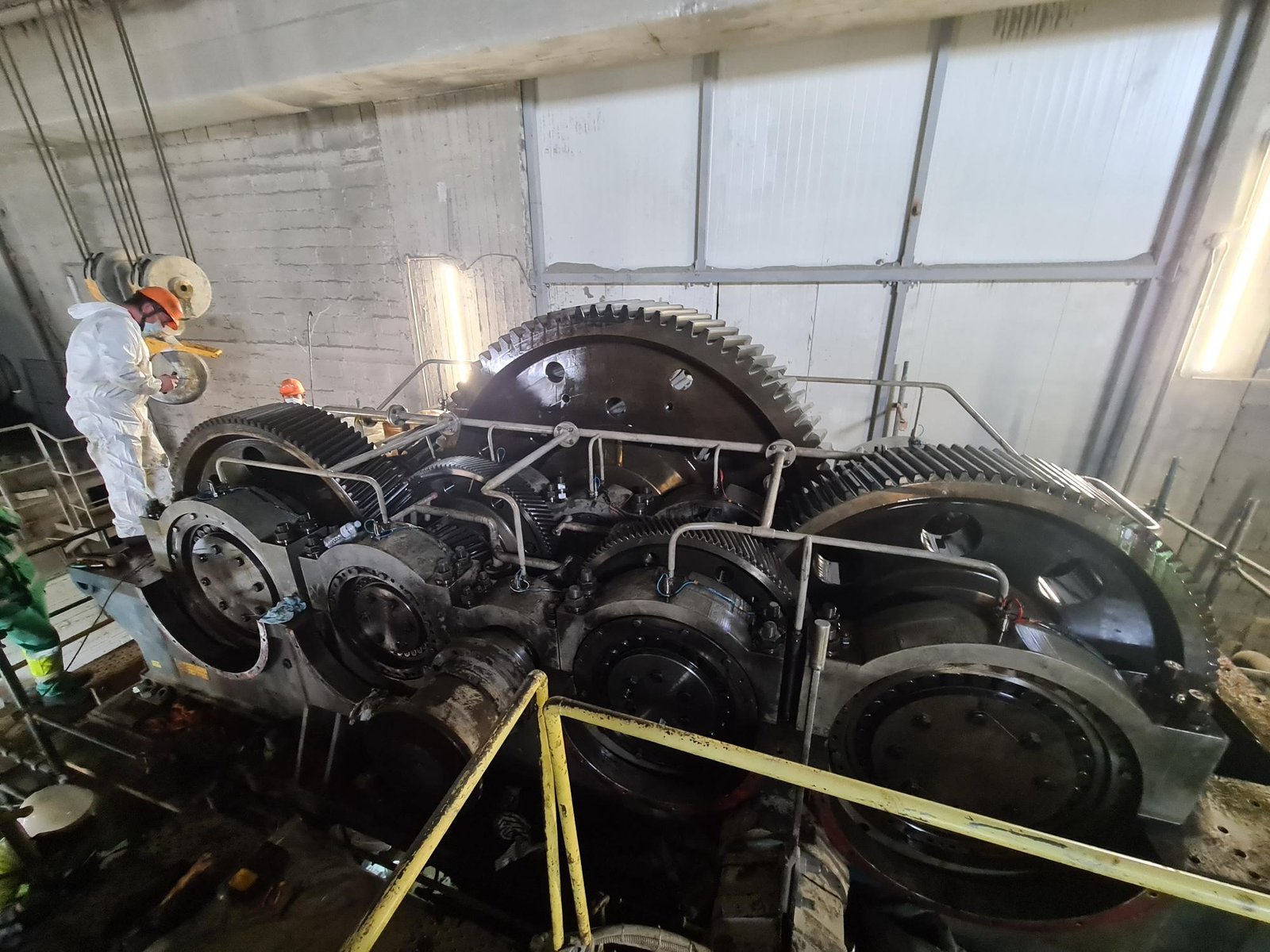
What Is Gearbox Lifetime Management?
Gearbox lifetime management is a long-term, condition-based program that manages a gearbox or driveline from a measured baseline to the end of its useful life, so that wear is found early and every repair, overhaul or replacement happens in a planned stop. It joins inspection, condition monitoring, spare-parts strategy, remaining-life assessment and overhaul planning into one documented plan for each critical drive. This guide defines each element and how they fit together.
Updated
Key points
- Gearbox lifetime management starts with a baseline inspection and ends with planned decisions on overhaul or replacement.
- Condition monitoring combines vibration, oil analysis and thermography, each trended against the baseline.
- In mining, inspection and overhaul should at minimum be planned for annual extended shutdowns; SAG mills and crushers benefit from more frequent condition checks based on operating hours and oil analysis.
- Spare-parts strategy and remaining-life assessment turn condition data into budgets and shutdown scopes.
- Preventive maintenance repeats fixed tasks on a calendar; lifetime management decides what to do, and when, from measured condition.
On this page (9)
- What is gearbox lifetime management?
- What are the elements of a gearbox lifetime management program?
- Why does gearbox lifetime management start with a baseline inspection?
- Which condition monitoring methods are used for gearboxes?
- How are gearbox inspection intervals set in a lifetime management program?
- What is the role of spare parts and remaining-life assessment?
- How does lifetime management plan gearbox overhauls?
- How is gearbox lifetime management different from preventive maintenance?
- Frequently asked questions
What is gearbox lifetime management?
Gearbox lifetime management is a structured program that tracks the condition of an industrial or marine gearbox over its whole service life and uses that data to plan maintenance, spares, overhauls and replacement. It is based on a measured baseline, regular condition monitoring and defined inspection intervals. Its purpose is to avoid unplanned stops and to get the full useful life from the gearbox.
The term covers the whole driveline where the gearbox sits: motor coupling, gearbox, output coupling and, on mills and kilns, the pinion and girth gear. Damage in one part often starts in another, so the program follows the complete drive train.
A gearbox lifetime management program answers four questions for each critical drive:
- What condition is the gearbox in now?
- How fast is that condition changing?
- What must be done, and in which planned stop?
- Which parts must be available before that stop?
The approach fits within wider asset management. ISO 55000:2024 gives the vocabulary and principles of asset management, while ISO 17359:2018 gives general procedures for setting up a condition monitoring programme for machines.
What are the elements of a gearbox lifetime management program?
A gearbox lifetime management program has six elements: a baseline inspection, condition monitoring, inspection intervals, a spare-parts strategy, remaining-life assessment and overhaul planning. Each element produces a specific output, and each output feeds the next. The table lists the elements, the usual tools and methods, and the outputs a maintenance or reliability engineer should expect.
| Element | Typical tools and methods | Outputs |
|---|---|---|
| Baseline inspection | Visual inspection through covers, tooth contact pattern, backlash, bearing condition, alignment, oil sample, vibration and temperature readings | Documented as-found condition, reference values for trending |
| Condition monitoring | Vibration measurement, oil analysis, thermography, temperature and oil pressure trends | Trend charts, alarm levels, early warnings |
| Inspection intervals | Criticality ranking, operating hours, shutdown calendar, monitoring results | Inspection schedule per drive, linked to planned stops |
| Spare-parts strategy | Parts lists, lead-time review, criticality and failure history | Critical spares list, order points for long-lead items |
| Remaining-life assessment | Measured wear and damage compared with duty, load history and design rating | Estimate of remaining service life, risk ranking |
| Overhaul planning | Findings, parts availability, shutdown windows, on-site or workshop route | Overhaul scope, timeline estimate, budget basis |
A program is only as good as its records. Every inspection and overhaul should end with a written report, and each report becomes the reference for the next one. See what a gearbox inspection report should contain.
Why does gearbox lifetime management start with a baseline inspection?
Gearbox lifetime management starts with a baseline inspection because every later measurement is judged against it. A vibration level, oil result or tooth contact pattern means little on its own. Compared with a documented starting point, the same value shows whether the gearbox is stable or deteriorating. The baseline also records damage that already exists, so it is not mistaken for new damage later.
A baseline is taken on a new or newly overhauled gearbox, or on an existing gearbox when the program starts. It typically records:
- Tooth condition on each stage, described in standard terms such as ISO 10825-1:2022
- Contact pattern and backlash
- Bearing condition where visible, and bearing temperatures at known load
- Shaft alignment to motor and driven machine
- Vibration readings at fixed measurement points
- An oil sample with viscosity, water, wear metals and particle count
On a mill or kiln, the baseline should include the pinion and girth gear. See girth gear inspection frequency. A gearbox inspection provides the condition assessment that the baseline needs.
Which condition monitoring methods are used for gearboxes?
The condition monitoring methods used for gearboxes are vibration measurement, oil analysis and thermography, supported by trends of bearing temperature, oil temperature and oil pressure. Each method detects different problems at different stages. Vibration shows gear mesh and bearing faults, oil analysis shows wear and contamination, and thermography shows heat from friction, misalignment or poor lubrication.
Vibration
Vibration is measured at fixed points on bearing housings and trended over time. ISO 20816-9:2020 covers the measurement and evaluation of vibration on gear units from 10 kW to 100 MW. It is aimed mainly at acceptance testing, and by agreement it can also guide operational monitoring. For low-speed mill drives, trends against the baseline usually say more than a single reading.
Oil analysis
- Viscosity: confirms the oil is still in grade.
- Water: water accelerates bearing and gear damage.
- Wear metals: elemental analysis shows small wear particles; a particle quantifier also detects larger ferrous debris.
- Cleanliness: particle counts are often reported as an ISO 4406 code.
- Oxidation and acid number: show lubricant degradation.
As a Machinery Lubrication article on gearbox oil analysis notes, trends against a baseline matter more than single results. Lubricant selection and condition for industrial gearing are covered by ANSI/AGMA 9005-F16.
Thermography
Infrared thermography shows hot bearings, uneven heating across a gear mesh and lubrication faults. ISO 18434-1:2008 sets out general procedures for thermography in machine condition monitoring.
ISO 17359:2018 describes how to choose methods, intervals and alarm criteria for a monitoring programme.
How are gearbox inspection intervals set in a lifetime management program?
Gearbox inspection intervals in a lifetime management program are set from the criticality of the drive, its operating hours and duty, the plant's shutdown calendar and the condition monitoring results. In mining, inspection and overhaul should at minimum be planned for annual extended shutdowns. High-load equipment such as SAG mills and crushers benefits from more frequent condition checks based on operating hours and oil analysis.
- Criticality: a single-line SAG mill, kiln drive or main propulsion gearbox ranks higher than a drive with standby.
- Duty: shock loads, high torque and dusty or wet environments shorten intervals.
- Shutdown calendar: inspections that need the gearbox stopped are tied to planned stops.
- Condition: a worsening trend brings the next inspection forward.
For girth gears, Hedberg Technical Services recommends a full girth ring and pinion inspection with wear measurement at every kiln or mill stop, and monthly alignment checks between major stops. See gearbox services for mining.
What is the role of spare parts and remaining-life assessment?
Spare parts strategy and remaining-life assessment turn condition data into decisions. Remaining-life assessment estimates how long a gearbox can keep running safely by comparing measured wear and damage with its duty and design rating. The spare-parts strategy makes sure the parts that estimate calls for, especially long-lead gears and large bearings, are available before the planned stop.
Remaining-life assessment
The assessment combines inspection findings, monitoring trends and operating history: load, hours, starts and any overload events. Design ratings come from methods such as the ISO 6336 series for gear load capacity and ISO 281:2007 for rolling bearing rating life. Measured condition then corrects the calculated figure, because ISO 281 does not cover wear or corrosion and real duty often differs from design duty.
Spare-parts strategy
- List the parts each critical gearbox needs for a planned overhaul and for a likely failure.
- Check lead times; gear sets and large special bearings often have the longest.
- Decide which parts to hold in stock, which to order at a trigger point, and which can be bought when needed.
- Review the list after each inspection.
Whether to repair, overhaul or replace is covered in gearbox repair or replace.
How does lifetime management plan gearbox overhauls?
Gearbox lifetime management plans overhauls from measured condition, so the scope, parts and route are known before the gearbox is opened. In Hedberg Technical Services' experience, an on-site overhaul of a cement mill gearbox typically takes 3 to 10 days, depending on size and condition. Shipping a large industrial gearbox to a workshop typically means 4 to 12 weeks of downtime.
These figures are typical ranges from experience, not guarantees. A timeline estimate for a specific gearbox follows the initial assessment.
Overhaul planning in a lifetime program covers:
- The scope, set from the latest inspection and monitoring trends
- The route: on site or in a workshop, see on-site vs workshop gearbox overhaul
- Parts ordered against the spare-parts strategy
- The shutdown window, coordinated with other work such as a mill reline
- Reporting, so the as-left values become the next baseline
The steps of a mill gearbox overhaul are described in the SAG mill gearbox overhaul procedure.
How is gearbox lifetime management different from preventive maintenance?
Gearbox lifetime management differs from preventive maintenance in what triggers the work. Preventive maintenance repeats fixed tasks, such as oil changes and inspections, at fixed calendar or running-hour intervals. Lifetime management uses measured condition and trends to decide what to do and when, and it covers long-term decisions on spares, overhaul and replacement that preventive maintenance does not address.
| Aspect | Preventive maintenance | Gearbox lifetime management |
|---|---|---|
| Trigger | Calendar or running hours | Measured condition and trends, within planned stops |
| Time horizon | The next task | The remaining service life of the gearbox |
| Data use | Task completed or not | Baseline, trends and remaining-life estimate |
| Spares | Consumables for routine tasks | Critical spares and long-lead items planned against condition |
| Outputs | Work orders | Inspection reports, overhaul scopes, budget basis |
The two work together. Routine tasks such as oil changes and filter checks stay in the preventive plan. Lifetime management adjusts their intervals and adds the decisions they cannot make.
Hedberg Technical Services sets up gearbox and driveline lifetime management programs with condition monitoring strategies, maintenance planning and technical recommendations. See gearbox lifetime management.
Frequently asked questions
Is gearbox lifetime management the same as condition monitoring?
No. Condition monitoring is one element of gearbox lifetime management. Lifetime management also includes the baseline inspection, inspection intervals, spare-parts strategy, remaining-life assessment and overhaul planning, and uses monitoring data to make decisions about the gearbox over its whole service life.
Which gearboxes justify a lifetime management program?
Gearboxes justify a lifetime management program when a failure would stop production or a vessel and replacement parts have long lead times. Typical examples are SAG, AG and ball mill gearboxes, crusher drives, kiln drives with girth gears, and marine propulsion and thruster gearboxes.
How often should a mining gearbox be inspected?
Inspection and overhaul of mining gearboxes should at minimum be planned for annual extended shutdowns. High-load equipment such as SAG mills and crushers benefits from more frequent condition checks, with the timing based on operating hours and oil analysis results.
Can the remaining life of a gearbox be calculated exactly?
No. Design methods such as ISO 6336 for gears and ISO 281 for bearings give calculated ratings, but they do not reflect real wear, contamination or overload history. A remaining-life assessment therefore combines calculation with measured condition and gives an estimate with a recommended action.
What does a gearbox lifetime management program deliver?
A gearbox lifetime management program delivers a condition monitoring strategy, an inspection schedule tied to planned stops, a critical spares list, remaining-life estimates and overhaul plans. Each inspection ends with a written report, which gives engineers a documented basis for budgets and shutdown scopes.
Does lifetime management replace preventive maintenance?
No. Routine preventive tasks such as oil changes, filter changes and lubrication checks remain. Gearbox lifetime management adjusts their intervals from measured condition and adds long-term decisions on spares, overhaul timing and replacement that a fixed preventive plan does not cover.
Sources and standards
- ISO 55000:2024 Asset management: Vocabulary, overview and principles (ISO)
- ISO 17359:2018 Condition monitoring and diagnostics of machines: General guidelines (ISO)
- ISO 20816-9:2020 Mechanical vibration: Measurement and evaluation of machine vibration, Part 9: Gear units (ISO)
- ISO 4406:2021 Hydraulic fluid power: Fluids, Method for coding the level of contamination by solid particles (ISO)
- ISO 18434-1:2008 Condition monitoring and diagnostics of machines: Thermography, Part 1: General procedures (ISO)
- ISO 6336-1:2019 Calculation of load capacity of spur and helical gears, Part 1: Basic principles, introduction and general influence factors (ISO)
- ISO 281:2007 Rolling bearings: Dynamic load ratings and rating life (ISO)
- ISO 10825-1:2022 Gears: Wear and damage to gear teeth, Part 1: Nomenclature and characteristics (ISO)
- ANSI/AGMA 9005-F16 (R2021) Industrial Gear Lubrication (ANSI Webstore)
- Oil Analysis Interpretation for Gearboxes, Jesus Teran Dagnino, Machinery Lubrication
Keep reading
Related pages
SAG Mill Gearbox Overhaul Procedure
SAG mill gearbox overhaul procedure step by step: shutdown planning, lock-out, lifting, disassembly, measurement, reassembly, alignment and…
Read more →
Gearbox Borescope Inspection
Gearbox borescope inspection: what an endoscope can and cannot see, access points, gear tooth and bearing checks, when to open the gearbox and what…
Read more →
Gearbox Lifetime Management
Gearbox lifetime management: remaining-life assessment, condition monitoring strategy and maintenance planning that turn breakdowns into planned…
Read more →
Industrial Gearbox Inspection
On-site industrial gearbox inspection for mining, cement and marine drives. Find wear, damage and remaining service life before they stop production.
Read more →
Gearbox Inspection Report
What a gearbox inspection report should contain: findings, measurements, photos, contact patterns, backlash, bearings, oil analysis and remaining…
Read more →
Gearbox Repair or Replace
Gearbox repair or replace: how housing, gear and bearing condition, new-unit lead time, downtime cost and upgrade options decide the right choice.
Read more →
Get in touch
Talk to a gearbox specialist
Setting up a lifetime program for critical gearboxes? Send Per Hedberg the drive list and recent inspection or oil data to discuss a program.
Phone +34 621 03 40 48 · Email hedbergtech@pm.me